
Category: Business

  • The Importance of Final Merits Determination In Your EB1A Application

    The Importance of Final Merits Determination In Your EB1A Application

    The final merit determination is the second step of the two-step EB-1A adjudication process. While many applicants invest a great deal into creating an organic eb1a profile, they often don’t prepare for the final merits determination stage well. On the contrary, it is more organic to prepare for the final merit stage early on in the career and organize your profile narrative accordingly.

    Here is a clear overview of the two-fold structure of EB1A adjudication. A prior knowledge of th adjudication structure will help you prepare better from the outset. A tailored EB1a mentorship can help you prepare for the ‘final merit’ through strategic guidance.  

    What is the final merit determination?

    The Final Merits Determination is the second stage of the USCIS EB-1A adjudication process.

    First, USCIS checks whether the applicant fulfills at least three of the regulatory criteria, such as:

    • published material,
    • judging,
    • original contributions,
    • awards,
    • high salary,
    • critical role,
    • scholarly articles,
    • and other qualifying evidence.

    However, satisfying three criteria does not automatically guarantee approval.

    After this initial step, USCIS conducts a broader qualitative analysis known as Final Merits Determination. During this stage, officers evaluate the totality of the evidence to decide whether the applicant truly demonstrates extraordinary ability.

    This means USCIS asks a much deeper question:

    “Does this entire profile genuinely show sustained acclaim and top-level expertise?”

    This stage is often the defining factor between approval and denial. In other words, you may fulfill all the requirements in the first stage and yet fail to secure an approval in the second.

    Why final merits determination matters so much

    At this point, the officer is no longer merely checking whether documents exist. Instead, USCIS evaluates whether the entire profile, viewed as a whole, genuinely demonstrates sustained national or international acclaim. This distinction is extremely important. Many applicants mistakenly approach the EB-1A as a checklist-driven process, and they focus primarily on accumulating evidence without considering how the pieces of evidence work together. But the Final Merits Determination is fundamentally about the integrity of the threads of evidence.

    What do the USCIS officers look for in this stage? 

    An applicant may technically satisfy three or even four criteria and still fail if the profile does not create a convincing impression of extraordinary ability. USCIS officers increasingly examine the quality and significance of evidence rather than its quantity alone. A person may present numerous media articles, yet those articles may come from insignificant platforms with little authority. Someone may show judging experience, but the judging invitations may appear weak or unrelated to meaningful professional recognition.

    This is why Final Merits Determination has become one of the most critical aspects of modern EB-1A adjudication. USCIS wants to determine whether the applicant truly stands apart from others in the field. The officer evaluates whether the achievements collectively demonstrate a career marked by influence and sustained recognition.

    The question of sustained acclaim

    One of the most important elements USCIS examines during Final Merits Determination is sustained acclaim. Extraordinary ability is not intended to reward temporary success or isolated achievements. USCIS wants evidence that the applicant has maintained professional recognition over time. A single successful project or one-time recognition is rarely enough. Instead, the profile must demonstrate continuity of excellence.

    Narrative coherence in your profile

    The idea of narrative coherence also plays a major role in Final Merits Determination. Strong EB-1A petitions usually tell a unified story. The evidence reinforces one another naturally. A researcher’s scholarly publications may support their judging activities. Their judging invitations may reinforce claims of critical role and international recognition. Media coverage may further validate the significance of their original contributions. When the profile feels interconnected, USCIS is more likely to perceive the applicant as genuinely distinguished. If you want to strengthen the narrative consistency of your profile, you can consider the eb1a visa consultancy services to eliminate weak links from your profile.

    The risks of a fragmented profile

    If the evidence appears disconnected or artificially assembled solely for immigration purposes, officers may become skeptical. USCIS has become increasingly experienced in identifying applications built around superficial or low-quality achievements. This is particularly true in an era where paid publications, and manufactured recognitions have become more common. As a result, Final Merits Determination now serves as a safeguard against profiles that technically satisfy criteria but fail to demonstrate real extraordinary ability.

    The role of recommendation letters

    Recommendation letters also play an interesting role during this stage. Many applicants believe that obtaining multiple letters from experts guarantees success. In reality, recommendation letters are persuasive only when supported by strong objective evidence. Letters work best when they explain why these achievements matter rather than merely praising the applicant in generic language.

    The psychological nuance of the final merits determination

    There is also a psychological dimension to Final Merits Determination that many applicants underestimate. Immigration officers review countless petitions, and over time, they develop a strong instinct for distinguishing ordinary professional success from truly exceptional careers. A well-structured EB-1A petition creates a consistent impression of authority and influence. The officer should naturally feel that the applicant operates at a level beyond the ordinary standards of the profession. This perception often emerges not from one individual document, but from the cumulative force of the entire profile.

    For this reason, organic profile building has become increasingly important in EB-1A strategy. The strongest applicants are rarely those who hurriedly collect evidence within a few months. Instead, they are individuals whose careers naturally reflect progression and impact. Their achievements feel authentic because they are rooted in genuine professional excellence rather than immigration-driven profile engineering.

    In the end, USCIS is asking a simple but profound question: Does this individual truly belong among the small percentage at the top of their field? The Final Merits Determination exists to answer precisely that question, and in many EB-1A cases, it becomes the deciding factor between approval and denial.
  • Does My Salary Meet The EB-1A Criteria? A Detailed Breakdown

    Does My Salary Meet The EB-1A Criteria? A Detailed Breakdown

    One of the most common and misunderstood questions in the EB-1A journey that plagues every applicant one way or another is this: “Is my salary high enough to qualify?”

    At first glance, the answer seems simple. But in reality, the EB-1A “high salary”  criterion is far more nuanced than a number on your paycheck. If you are working with EB-1A experts, understanding how salary is evaluated can make or break your petition.

    Let’s break it down clearly.

    The truth: There is no fixed salary requirement

    The biggest misconception is that EB-1A requires a specific income threshold, like $200,000 or $500,000.

    That’s not how it works.

    According to U.S. Citizenship and Immigration Services (USCIS), the actual requirement is:

    Evidence that you command a high salary relative to others in your field

    This means your salary is judged comparatively, not absolutely. A $120,000 salary could be extraordinary in one profession but average in another.

    What “High Salary” really means

    So what qualifies as “high”?

    In most successful EB-1A cases, your earnings should fall within the top 10% (or 90th percentile) of professionals in your field.

    This signals that:

    • Your skills are in exceptional demand
    • Your expertise is valued above peers
    • You are among the top performers in your domain

    Importantly, this benchmark varies by:

    • Industry (tech vs academia vs healthcare)
    • Geography (New York vs smaller cities)
    • Experience level

    As noted in immigration analyses, the same salary can be considered ordinary in one region but extraordinary in another. The context matters more than the fixed number.

    It is not just salary, but total compensation

    Here is yet another key insight: EB-1A is not limited to base salary.

    USCIS often also considers:

    • Bonuses
    • Stock options
    • Commissions
    • Equity compensation

    When combined, these can significantly strengthen your claim. The goal is to demonstrate overall remuneration that exceeds industry norms, not just a base paycheck.

    What evidence do you need to provide to fulfil the criteria?

    Simply stating your salary might not be enough. On the contrary, you must prove it with credible documentation that the total cost you draw is significantly higher than that of your peers and others in the same job roles.

    Your strong evidence includes:

    • Tax returns and pay slips
    • Employment contracts or offer letters
    • Salary comparison reports (e.g., industry surveys)
    • Government wage data (like labour statistics)

    USCIS specifically expects comparative data to show how your income stacks up against others in your field.

    Without this comparison, even a high salary may fail to meet the criterion.

    Why salary matters in EB-1A

    Salary is not just about money: it is also about recognition within your field.

    A high salary demonstrates:

    • Market validation of your expertise
    • Demand for your skills
    • Your position among the top professionals

    In fact, immigration experts often consider salary one of the most objective EB-1A criteria because companies don’t overpay without reason.

    However, it is still just one piece of the puzzle. You need to contextualise it within the entire claim of your extraordinary impact.

    The Biggest Mistake Applicants Make

    Many applicants believe:

    “If I earn a high salary, I automatically qualify.”

    That’s incorrect.

    EB-1A requires meeting at least 3 out of 10 criteria, and even then, you must pass the final merits evaluation.

    Salary alone is rarely sufficient.

    Common mistakes include:

    • Not providing comparative wage data
    • Ignoring geographic salary differences
    • Assuming a high income equals extraordinary ability
    • Failing to connect salary with impact and recognition

    This is where experienced EB-1A consultants play a critical role to position salary within a broader narrative of excellence.

    When your salary isn’t “High Enough”

    Here’s the encouraging part:

    Even if your salary doesn’t meet the top percentile, you can still qualify for EB-1A.

    You can compensate with:

    • Strong publications or citations
    • Major contributions to your field
    • Leadership roles
    • Media recognition

    The EB-1A is a holistic evaluation, not a single-metric test.

    In fact, many successful applicants don’t use salary at all. Instead, they choose to focus on other criteria instead.

    Strategic insight: positioning matters more than numbers

    The real takeaway?

    Your salary doesn’t need to be “impressive”. It needs to be strategically positioned.

    A strong EB-1A petition will:

    • Compare your salary with credible benchmarks
    • Explain why your compensation is exceptional
    • Link your earnings to your impact and expertise

    This is why working with a specialised EB-1A green card consultancy can be a game-changer. They can mentor you to translate the raw numbers into persuasive legal arguments.

    In place of conclusion

    So, does your salary meet the EB-1A criteria?

    The honest answer: It depends.

    The criteria is not merely fulfilled on the number; but on:

    • How does it compare to your peers
    • How well it is documented
    • How effectively it is presented

    In the EB-1A process, salary works like an evidence of excellence. And when used correctly, it can become one of the strongest pillars of your petition.

  • Vograce Clear Acrylic Keychains Pricing Guide (2026)

    Vograce Clear Acrylic Keychains Pricing Guide (2026)

    Custom keychains remain one of the most popular ways to showcase creativity, promote brands, and create personalized gifts. Among the many materials available, clear acrylic stands out for its sleek look, durability, and versatility. Vograce, a leading platform for custom merchandise, has made it easier than ever to create high-quality acrylic keychain products at competitive prices. In this 2026 pricing guide, we’ll break down the factors that influence cost, explore different options, and provide tips to get the best value for your order.

    Why Choose Clear Acrylic Keychains?

    Clear acrylic keychains offer several advantages over other materials:

    • Vibrant Printing: The transparent acrylic surface enhances colors, making designs appear crisp and bright.
    • Durability: Acrylic is lightweight, water-resistant, and less prone to breaking than glass or resin.
    • Versatility: Keychains can be fully customized in shape, size, color, and finishes.
    • Affordability: Despite their high-quality appearance, acrylic keychains are budget-friendly, especially when ordered in bulk.

    An acrylic keychain is suitable for personal projects, event merchandise, or business promotions, making it one of the most versatile products in the custom accessory market.

    Factors That Affect Pricing

    Several factors influence the cost of a Vograce clear acrylic keychain. Understanding these can help you plan your budget effectively.

    1. Quantity Ordered

    Quantity is one of the biggest determinants of price per unit. Ordering in bulk significantly reduces the cost:

    • Small orders (1–50 pieces) have a higher per-unit price.
    • Medium orders (50–200 pieces) usually benefit from bulk discounts.
    • Large orders (200+ pieces) offer the lowest per-unit cost.

    If you plan to sell or distribute your acrylic keychain products, ordering larger quantities is often more cost-effective.

    2. Size of the Keychain

    Size directly affects the amount of material and printing required:

    • Small (1–2 inches): Ideal for simple designs; most affordable.
    • Medium (2–3 inches): Balanced size for detailed artwork.
    • Large (3–4 inches): Best for complex designs; slightly higher cost.

    Choosing the right size ensures your keychain is both practical and visually appealing without unnecessary costs.

    3. Shape Customization

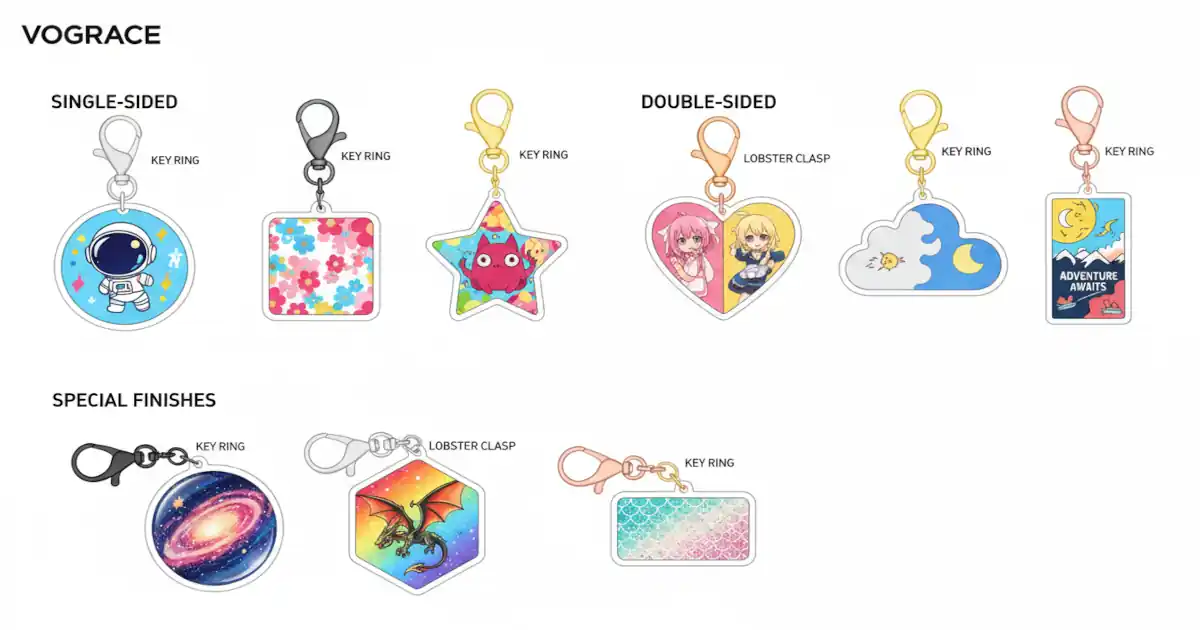
    Vograce allows custom die-cut shapes in addition to standard shapes like circles, squares, and rectangles.

    • Standard Shapes: Typically less expensive because they are easier to produce.
    • Custom Shapes: Slightly higher in price due to specialized cutting, but they can make your acrylic keychain stand out and attract more attention.

    4. Printing Options

    The printing method affects both the quality and the price:

    • Single-Sided Printing: Cost-effective option; design appears on one side only.
    • Double-Sided Printing: Prints on both sides; slightly higher cost but adds versatility.

    Double-sided printing is ideal for showcasing multiple designs or adding branding details.

    5. Special Finishes

    Special finishes can enhance your keychain but may increase costs:

    • Epoxy Coating: Adds a glossy, durable layer.
    • Holographic Effects: Reflective and visually striking.
    • Glitter Effects: Adds sparkle and fun.
    • Matte Finish: Subtle and sophisticated look.

    Selecting the right finish allows you to balance visual appeal with budget considerations for your acrylic keychain.

    6. Attachments

    The type of attachment also affects pricing:

    • Standard key rings are the most affordable.
    • Lobster clasps, chains, or hooks add slightly to the cost but can improve usability and aesthetics.

    Choosing an attachment depends on the keychain’s intended purpose and target audience.

    Vograce 2026 Pricing Overview

    While prices can vary depending on the above factors, here’s a general breakdown of Vograce acrylic keychain pricing in 2026:

    QuantitySingle-SidedDouble-SidedNotes
    1–10$3.50–$4.00$4.50–$5.00Ideal for personal gifts or prototypes
    11–50$2.80–$3.20$3.80–$4.20Small bulk orders with moderate discounts
    51–200$2.50–$2.80$3.50–$3.80Best for businesses or event merch
    200+$2.20–$2.50$3.00–$3.50Lowest per-unit cost for large orders

    Keep in mind that additional features like custom shapes, epoxy coating, or holographic finishes may increase the per-unit cost slightly. However, bulk discounts often offset these extras, making high-quality acrylic keychain designs accessible at any scale.

    Tips for Maximizing Value

    To get the best value for your Vograce order, consider the following tips:

    1. Order in Bulk

    Larger quantities reduce the per-unit price, making it more cost-effective for businesses or resellers.

    2. Choose Standard Sizes and Shapes

    While custom shapes look unique, standard options are more affordable and still allow for creative designs.

    3. Optimize Your Design

    Simple, bold designs are easier to print and often cost less than intricate artwork with fine details.

    4. Combine Features Strategically

    Consider which special finishes will truly enhance your keychain. For instance, holographic effects are eye-catching but may not be necessary for a minimalist design.

    5. Plan Ahead

    Allow enough time for production and shipping, especially for bulk orders. Last-minute orders may incur additional costs or rush fees.

    Best Uses for Vograce Acrylic Keychains

    Understanding the potential uses of your keychains can help justify your investment:

    • Brand Promotion: Distribute as giveaways or promotional items.
    • Event Merchandise: Ideal for weddings, corporate events, or parties.
    • Artist Merchandise: Sell unique designs online or at conventions.
    • Personal Gifts: Create meaningful, customized gifts for friends or family.

    The versatility of an acrylic keychain makes it a practical and appealing product across various applications.

    Conclusion

    Vograce clear acrylic keychains offer a wide range of customization options while remaining affordable and high-quality. By understanding the factors that influence pricing—quantity, size, shape, printing, finishes, and attachments—you can make informed decisions that balance cost with creative vision.

    Whether you’re designing keychains for personal use, event merchandise, or commercial sale, this 2026 pricing guide provides a clear roadmap to plan your budget and maximize value. With thoughtful design choices and strategic ordering, your acrylic keychain project can be both cost-effective and visually striking.

    By leveraging Vograce’s platform, you can create keychains that not only look professional but also serve as powerful marketing tools, collectible items, or personalized gifts. Knowing the pricing structure ahead of time ensures you can focus on creativity and quality without overspending.